A course in celestial navigation
Learn to find your position from the sky
Step-by-step lessons, practice that checks every step of your work, and the almanac and tables built in. On your phone or computer, at your own pace.
Free while it is being tested. Later, the first module stays free and the full course is a one-time purchase.
What you will be able to do
- Latitude from the noon SunThe classic first sight: know when noon is by your watch, measure it, and work out your latitude.
- Your compass, checkedFind the compass error from the Sun's bearing at sunrise or sunset.
- Latitude from PolarisAt twilight, the Pole Star and three small corrections give your latitude.
- A line of position from the SunReduce a sight with the almanac and Pub. 249, the way navigators do, and plot it.
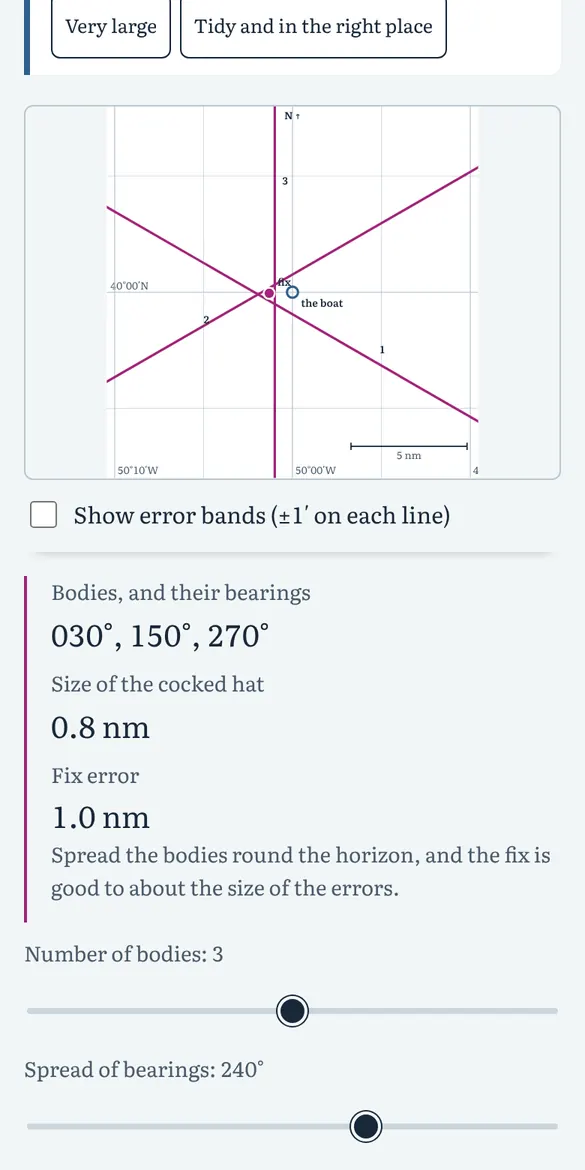
- A three-star fixPlan a round of twilight star sights with a star finder, then plot where the lines cross.
- Planets and the MoonBright planets at twilight, and a Sun–Moon fix in daylight.
What it looks like
How it works
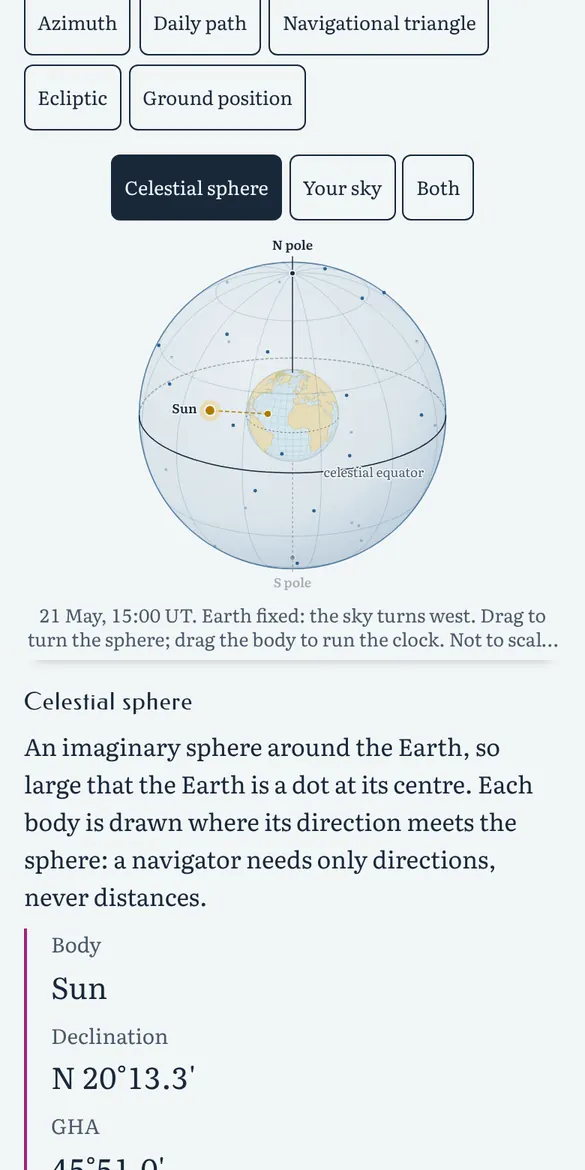
- Learn. Short lessons with globes and diagrams you can turn and drag. Guess first, then look: it is how the ideas stick.
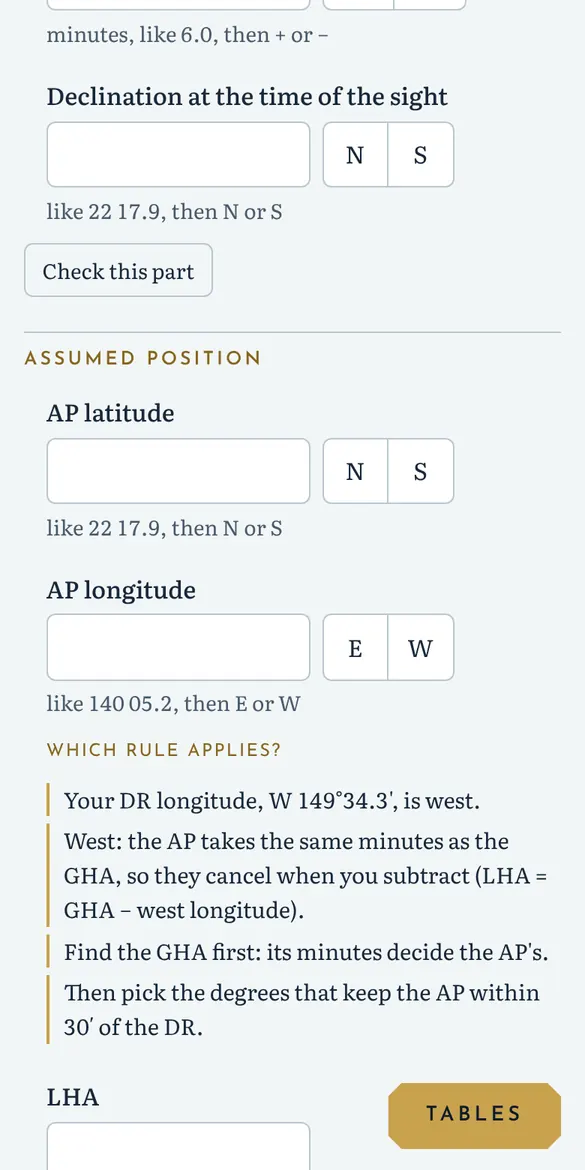
- Practice. Problems from the watch time and the sextant reading to the line on the chart. A mistake is caught at the step where you made it, with the rule and a worked example on request.
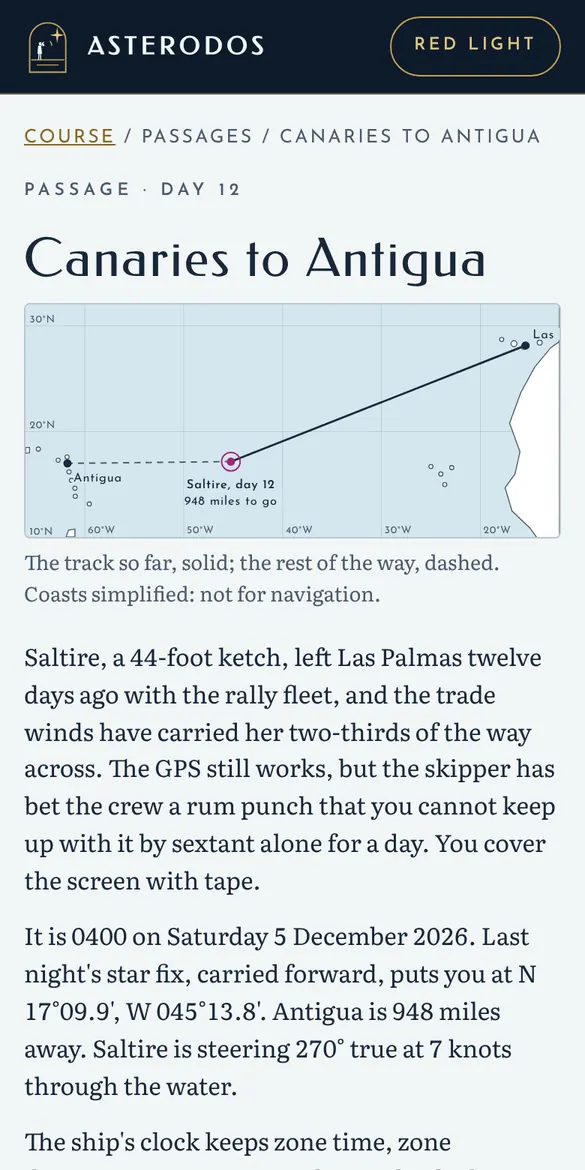
- Put it together. Passages across the Pacific and the Atlantic, and a final assessment on problems you have never seen.
Who it is for
Sailors getting ready for an ocean passage, or who want a backup when the electronics fail. Students on a celestial navigation course who want more practice than the book gives. And anyone who has wondered how navigators found their way before GPS: you can take real sights from your backyard.
Made by a sailor who wanted an easier way to learn celestial navigation.
Price
Free while it is being tested. Later, the first module stays free and the full course is a one-time purchase. No account, no adverts, no subscription.
Questions
Do I need a sextant?
No. Every problem gives you the sextant reading, or lets you take one in the built-in simulator. When you do get a sextant, "Work your own sight" reduces your real sights, at sea or on land with a tray of water.
How much math does it take?
Adding and subtracting degrees and minutes, and the occasional sine. A calculator that works in degrees and minutes is built into every problem.
Do I need to buy the almanac and tables?
Not to learn. The almanac (2026 to 2028, computed from NASA JPL's DE440 ephemeris) and Pub. 249 sight reduction tables are built in, and a guide explains how to use the printed ones.
Is it accurate?
The almanac and tables were checked against the printed Nautical Almanac extracts in Bowditch and every entry of the official Pub. 249 volumes 2 and 3. It is still a course for learning: at sea, navigate with the official publications.
Does it work on a phone, and offline?
Yes. It is designed for phones first, and once loaded it works without a signal, which is handy aboard.
Is it for beginners?
Yes. It starts from what latitude is, and every module has a skill check, so if you already know a topic you can solve one problem and skip ahead.